Helping building owners create an inclusive environment for staff and patrons, our Accessibility Consulting services focus on identifying barriers within built environments. Measuring tools—such as distance gauges, slope meters, and force gauges—are used to confirm compliance with accessibility design standards prescribed by legislation (e.g., building codes, regulations) and/or by organizations such as cities, municipalities, or institutions.
Using a prescriptive approach, we measure non-compliances and systematically assign improvement recommendations, resulting in a consistent and actionable dataset.
There is a growing need to accommodate persons with disabilities, and addressing accessibility barriers as part of space planning and/or capital and asset management has now become a requisite. Most major jurisdictions with the authority to do so have legislated a barrier-free environment as part of new construction and major renovations to existing buildings. Identifying accessibility barriers through comprehensive assessments or audits is the first step to making accessibility accommodations.
TARGETED SOLUTIONS
Areas of Expertise
When we started Roth IAMS, we recognized the need to assist clients in their efforts to provide inclusive environments that accommodate the needs of all staff and patrons. To meet this challenge, we developed a dedicated service area focused on identifying potential accessibility barriers within facilities through a suite of targeted services.
Tier I ADA Survey: Baseline Screening Accessibility Checklist
The checklist is generally used to supplement the condition data obtained during a BCA/FCA. The checklist, which is based on ASTM Standard E2018, is tailored to meet the building owners’ operational requirements. The completion of the checklist is based on visual observation. No measurements are taken to confirm the compliance. The checklist provides building owners, at a high level, with the accessibility barriers that may exist at their facilities.
Tier II ADA Survey: Enhanced Baseline Screening Checklist
The Tier II ADA Survey (Enhanced Baseline Screening) bridges the gap between a high-level screening and a comprehensive (full) accessibility assessment. The survey focuses on identifying key accessibility barriers along paths of travel and at critical amenities using a standardized on-site checklist based on recognized standards. Limited measurements are captured where required to confirm compliance and improve recommendation accuracy.
Tier III ADA Survey: Full Accessibility Assessment / Audit
A comprehensive or full AA audit helps building owners create an inclusive and accessible built environment for their staff and patrons. The audits identify potential accessibility barriers based on the applicable barrier-free accessibility design standard.
The design standard is either a Canadian-legislated requirement (OBC, NBC, Regulation, etc.), an American legal requirement (Americans with Disabilities Act), or developed by an organization or entity (CSA, City of London, etc.).
A comprehensive checklist, which is configured to include Uniformat II classification, is used to undertake the AA assessments/audits. Measuring tools are used to verify compliance with the design standards.
Rick Hansen Foundation Accessibility Certification
The facilitation of a facility to the RHFAC Registry to showcase the building owner’s commitment to creating an inclusive and accessible environment. The completion and submission of the RHFAC rating form for adjudication is undertaken by certified RHFAC Professionals.
Standards driven and site tested
How We Deliver Accessibility Assessments
We take a comprehensive, standards-based approach to accessibility assessments, combining detailed site evaluations with legislative compliance reviews to identify barriers and deliver practical, actionable recommendations.
Tier I
Baseline Screening Accessibility Checklist
The completion of a checklist prepared in collaboration with a building owner. The checklist is generally completed concurrently with a BCA/FCA assessment. The data stands alone (not integrated with the BCA/FCA data), and the checklist is included as an appendix to the BCA/FCA report.
Tier II
Enhanced Baseline Screening Checklist
The completion of an extensive checklist that covers additional categories and parameters of barriers not included in the Tier I Survey. Measuring tools are used to confirm compliance with the applicable barrier-free accessibility design standards. The checklist is included as an appendix to the BCA/FCA report. Accessibility improvement recommendations can be incorporated into the BCA/FCA as an option.
Tier III
Full Accessibility Assessment / Audit
The completion of a comprehensive checklist that is structured to address the barrier-free accessibility design standards prescribed by the jurisdiction having authority. Measuring tools are used. The data, which includes accessibility improvement recommendation with a renewal budget cost (Class D estimate), is either integrated into BCA/FCA report or provided as a standalone report to the building owner. Given potential cash flow constraints, an additional optional service, where a priority matrix is developed in collaboration with the building owner and applied to the accessibility improvements, can be provided.
Certification
Rick Hansen Foundation Accessibility Certification
The process for registration begins with the building owner, either directly or indirectly through us, setting up the facility on the RHFAC registry. The interactive RHFAC rating survey is completed by our RHFAC professionals for adjudication, and where shortfalls are identified, concept drawings to address the barrier are provided. Where required, a separate report that identifies accessibility shortfalls and recommendations is also provided.
Featured Projects
Our featured accessibility projects highlight our commitment to creating inclusive environments, showcasing tailored solutions that address unique site challenges.
What differentiates Barrier-Free Accessibility vs. Universal Design in facilities?
Barrier-Free: Removing barriers for people with disabilities, so that they may have access to and within a facility.
Universal Design: “The design of products and environments to be usable by all people, to the greatest extent possible, without the need for adaptation or specialized design.” —Ronald Lawrence Mace (1988)
While it may not always be financially or physically feasible, the Universal Design approach is the most inclusive and applies to a broad range of users.
For example, while a service entrance at the side or rear of a building may be used as an accessibility entrance, this segregates building users with disabilities. The service entrance is usually aesthetically unappealing and may even compromise individual safety, as it’s hidden from view. This may provide barrier-free accessibility, but would not be considered Universal Design, which would provide the same means of entry for all users at the building’s entrance. With universal design, since all users are treated equally, none are stigmatized.
What are the best practices for understanding legislative requirements?
Since legislative requirements often vary, knowing the ones that apply in your jurisdiction is essential. You should refer to the building codes and barrier-free design standards that are applicable under the relevant legislation, like the Americans with Disabilities Act, Accessibility for Ontarians with Disabilities Act, etc.
Before space planning, it will be essential to understand:
When accessibility improvements are required
What improvements are required
How those improvements are to be made
Which Accessibility Assessment is right for your facility?
Barriers to accessibility can be identified in several ways, including:
Baseline screening accessibility checklists: ideal for quick evaluations of buildings/sites, and to gain a general understanding of accessibility in a large facility asset portfolio.
Comprehensive accessibility audits: ideal for confirmation of compliance with code or guidelines, and identifying specific areas of improvement.
The Rick Hansen Foundation Accessibility Certification survey: ideal for promoting and/or comparing levels of meaningful access between various assets, with a focus on universal design.
Choosing the right audit is based on an organization’s needs and should take into consideration whether a high-level or in-depth analysis is needed, the number of assets, and the timelines involved.
Our Services
We span the full spectrum of truly integrated asset management
Roth IAMS guides you through the Asset Management process to determine the best solutions to fit your budget and to meet your timelines.
Since 2014, Roth IAMS has completed over 21,000 Building and Facility Condition Assessments (BCAs, FCAs) for public and private clients across North America. Our full-time, multidisciplinary team provides tailored, defensible data to support prioritized multiyear capital renewal plans. We customize our scope of work and data collection to align with each client’s specific business and project needs.
We work with organizations to strengthen their Facilities Management programs through strategic guidance, proven methodologies, and customized solutions tailored to their portfolios. From Preventative Maintenance (PM) planning and equipment inventory to software selection, construction handover support, and lifecycle cost analysis, our services support every stage of the facilities lifecycle—helping clients improve building performance, extend asset life, and align daily operations with long-term asset management goals.
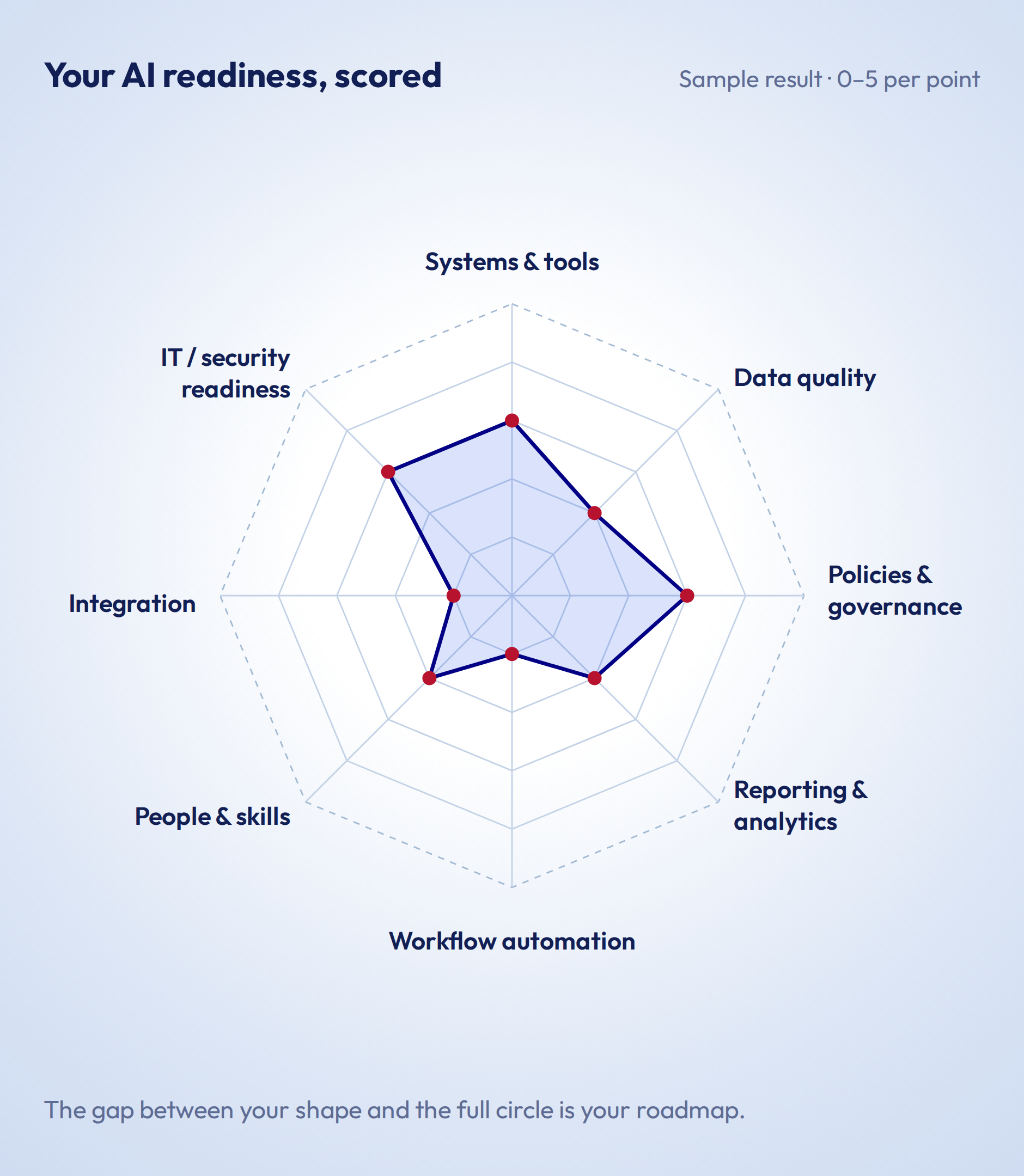
Your work-order system, asset register, space data, and utility bills already hold the information an AI tool needs. We help you find out which of it is trustworthy enough to build on, what your policies allow, and exactly where to start — then build and run the tools with you, if you want us to.
At Roth IAMS, we specialize in helping organizations enhance their Asset Management and Capital Planning efforts by building a reliable foundation of accurate and actionable asset data. Using innovative tools and proven strategies, we’ve partnered with hundreds of clients to collect, organize, and validate their data—enabling smarter decisions, effective maintenance planning, and alignment with long-term strategic goals.
Our Master & Space Planning services team creates data-driven, practical roadmaps for clients that align their facilities with program needs, enrollment trends, and available funding.
By combining facility data (FCAs, FCI, equipment inventories) with utilization, demographic, and enrollment analysis, we produce prioritized, actionable plans that help our clients mitigate risk, reclaim underused space, and guide capital investment decisions for their organizations.
Understanding how your facilities use energy is essential to controlling costs, meeting sustainability targets, and making informed decisions about building operations. Our energy audits and green building strategies provide valuable insights into usage patterns and highlight practical opportunities to improve building efficiency, reduce waste, and support your organization’s environmental goals.
Well-designed and properly constructed structures ensure the safety, stability, and longevity of buildings, bridges, retaining walls, and sidewalks of our built environment. However, structural integrity can become compromised over time—due to damage, age, or poor maintenance—requiring a structural assessment to re-ensure occupant safety and extend the life of the asset. These issues often reveal themselves through visible signs such as cracks, corrosion, settlement, or water infiltration.
Helping building owners create an inclusive environment for staff and patrons, our Accessibility Consulting services focus on identifying barriers within built environments.
Using a prescriptive approach, we measure non-compliances and systematically assign improvement recommendations, resulting in a consistent and actionable dataset.
We use cookies to ensure that we give you the best experience on our website. If you continue to use this site we will assume that you are happy with it.