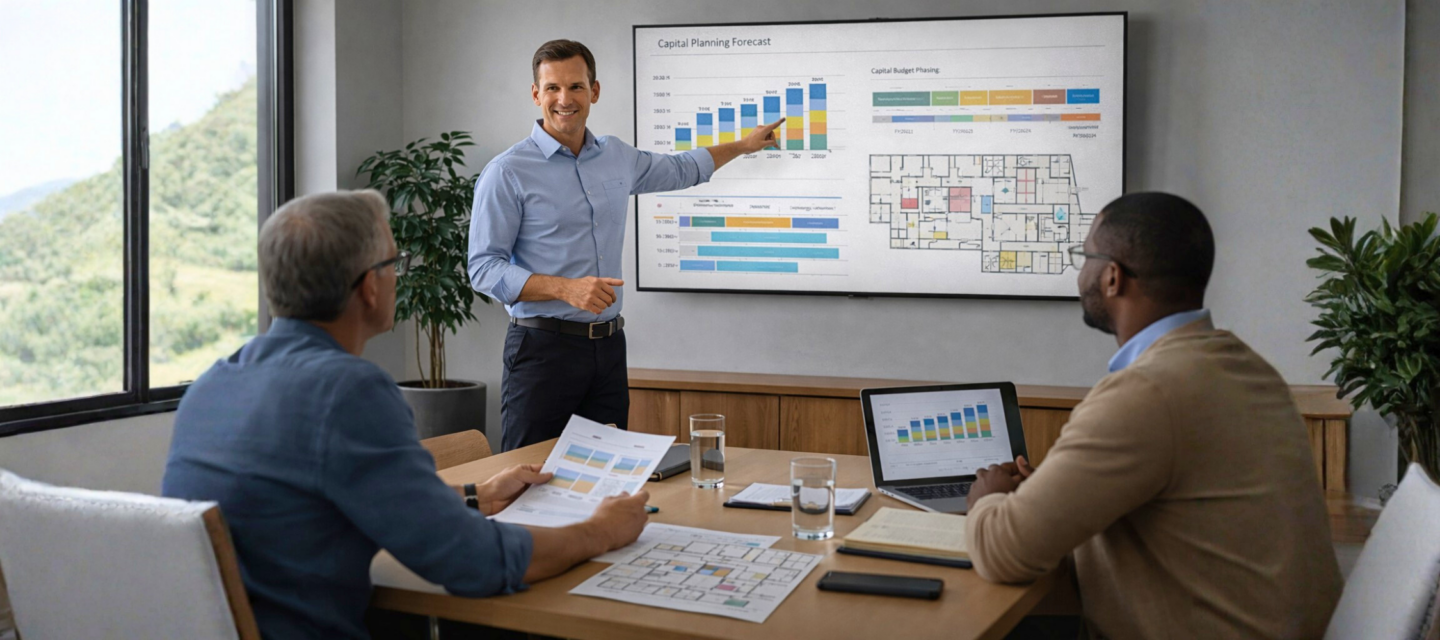
Our Master & Space Planning services team creates data-driven, practical roadmaps for clients that align their facilities with program needs, enrollment trends, and available funding.
By combining facility data (FCAs, FCI, equipment inventories) with utilization, demographic, and enrollment analysis, we produce prioritized, actionable plans that help our clients mitigate risk, reclaim underused space, and guide capital investment decisions for their organizations.
We help optimize program delivery and space allocation using:
Room schedules
Adjacency diagrams
Utilization heatmaps
Occupancy analysis
Turning Strategy Into Action
Capital Prioritization and Phasing
To support capital planning decisions, this work includes:
Prioritized project lists
Cost-estimating guidance
Phasing plans that align with regulatory requirements and funding cycles
Long-Term Asset Intelligence
Asset and Infrastructure Strategy
Integrates FCAs, equipment inventories, and life-cycle data into long-term asset management plans.
Simple, Transparent, Collaborative
The Roth IAMS Approach
to Master & Space Planning
Step 1
Discovery & Goals
Verify all service levels, the current use of space, and stakeholder needs.
Step 2
Data Collection & Validation
Integrate population and enrollment demographics, FCAs, FCIs, equipment inventories, accessibility audits, surveys, and utilization data into one comprehensive dataset for client use.
Step 3
Stakeholder Workshops & Design Charrettes
Host sessions with students, educators, facilities staff, community members, and business leaders to ensure plans address actual operational needs.
Step 4
Deliverables
An Executive master plan and roadmap (short, medium, long term).
Space program documents: room schedules, adjacency matrices, and maximized or minimized underutilized facility spaces.
Utilization maps and occupancy reporting (heatmaps, capacity).
Aligning Space, Demand, and Investment
Master & Space Planning Solves Problems
Master & Space Planning helps turn ambiguous data on population trends, capacity analysis, building states, and budgets into a clear renewal plan.
It enables organizations to:
Turn uncertain conditions and budgets into a clear, prioritized renewal strategy: what to replace, what to retain, and the optimal timing to match funding.
Improve space effectiveness: analyze classrooms, labs, offices, and support areas to right-size capacity and inform programming, staffing, and enrollment adjustments.
Reduce risk and inform capital decisions: combine condition, life-cycle, and cost data to sequence projects and maximize return on investment.
Frequently asked questions
Addressing common questions
for your convenience
What is Master & Space Planning, and why is it important?
Master & Space Planning aligns facilities with organizational goals, enrollment trends, and budgets to create a clear, data-driven roadmap that helps predict future needs and plan for renewal and growth.
By combining facility condition data, equipment inventories, and demographic insights, organizations can reduce risk, avoid reactive decisions, and prioritize investments with confidence.
What types of organizations benefit from these services?
These services are commonly used by educational institutions, municipalities, and organizations managing multiple facilities.
They are especially valuable for those experiencing enrollment changes, underused space, aging infrastructure, or upcoming capital investments.
Effective Master & Space Planning aligns demographic trends, program needs, and funding cycles.
How do facility condition data and space planning work together?
Facility condition data identifies what needs to be repaired or replaced, while space planning evaluates how well spaces support current and future needs.
Together, they provide a more complete picture to help prioritize projects and align capital investment with operational requirements.
What data is used to develop the plan, and where does it come from?
The planning process uses data such as FCAs, FCI scores, equipment inventories, accessibility audits, demographics, surveys, and occupancy reports. This data is validated early to ensure decisions reflect current conditions and trends.
Organizations do not need to have all data prepared in advance—we gather, organize, and verify it to create a reliable dataset that supports ongoing decision-making beyond the planning process.
What deliverables will we receive at the end of the process?
Clients are provided with planning documents, including an executive master plan, space program details, utilization maps, occupancy reports, and capital plans.
These helpful and practical deliverables are designed to guide investments, support budgeting efforts, and enable leadership to clearly communicate priorities to boards, funders, and communities.
Our Services
We span the full spectrum of truly integrated asset management
Roth IAMS guides you through the Asset Management process to determine the best solutions to fit your budget and to meet your timelines.
Since 2014, Roth IAMS has completed over 17,500 Building and Facility Condition Assessments (BCAs, FCAs) for public and private clients across North America. Our full-time, multidisciplinary team provides tailored, defensible data to support prioritized multiyear capital renewal plans. We customize our scope of work and data collection to align with each client’s specific business and project needs.
We work with organizations to strengthen their Facilities Management programs through strategic guidance, proven methodologies, and customized solutions tailored to their portfolios. From Preventative Maintenance (PM) planning and equipment inventory to software selection, construction handover support, and lifecycle cost analysis, our services support every stage of the facilities lifecycle—helping clients improve building performance, extend asset life, and align daily operations with long-term asset management goals.
Understanding how your facilities use energy is essential to controlling costs, meeting sustainability targets, and making informed decisions about building operations. Our energy audits and green building strategies provide valuable insights into usage patterns and highlight practical opportunities to improve building efficiency, reduce waste, and support your organization’s environmental goals.
At Roth IAMS, we specialize in helping organizations enhance their Asset Management and Capital Planning efforts by building a reliable foundation of accurate and actionable asset data. Using innovative tools and proven strategies, we’ve partnered with hundreds of clients to collect, organize, and validate their data—enabling smarter decisions, effective maintenance planning, and alignment with long-term strategic goals.
Helping building owners create an inclusive environment for staff and patrons, our Accessibility Consulting services focus on identifying barriers within built environments.
Using a prescriptive approach, we measure non-compliances and systematically assign improvement recommendations, resulting in a consistent and actionable dataset.
Well-designed and properly constructed structures ensure the safety, stability, and longevity of buildings, bridges, retaining walls, and sidewalks of our built environment. However, structural integrity can become compromised over time—due to damage, age, or poor maintenance—requiring a structural assessment to re-ensure occupant safety and extend the life of the asset. These issues often reveal themselves through visible signs such as cracks, corrosion, settlement, or water infiltration.
Our Master & Space Planning services team creates data-driven, practical roadmaps for clients that align their facilities with program needs, enrollment trends, and available funding.
By combining facility data (FCAs, FCI, equipment inventories) with utilization, demographic, and enrollment analysis, we produce prioritized, actionable plans that help our clients mitigate risk, reclaim underused space, and guide capital investment decisions for their organizations.
We use cookies to ensure that we give you the best experience on our website. If you continue to use this site we will assume that you are happy with it.