When Reducing Space Looks Like Reducing Public Service
In the previous posts in this series, we explored why downsizing space is rarely just a facilities decision, how that challenge plays out in K-12 education, why healthcare organizations face uniquely high stakes when adjusting their physical footprint, and how space in higher education often becomes intertwined with status and governance.
Municipal and state government portfolios present a different challenge altogether. Here, buildings are often viewed as the physical presence of government in a community. When a facility closes or services are consolidated, the public rarely sees it as an operational adjustment. More often, it is interpreted as a loss, and an emotional one at that, even when the services themselves remain unchanged, or in some cases are improved.
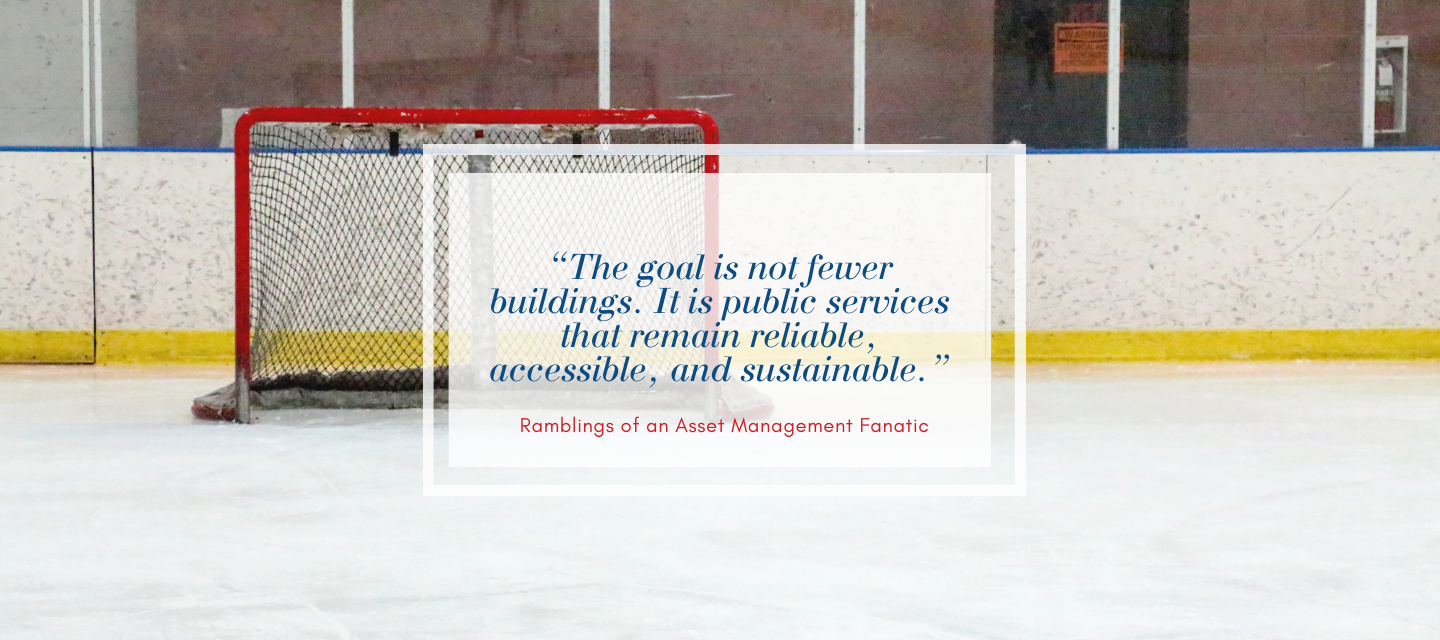
I grew up in a small town. Despite our size, we had a local hockey arena that played a critical role in our community fabric. However, when I was a kid it was already a bit long in the tooth and showing signs of age. Before I moved away there was talk of closing the arena and expanding the one in the nearby town. Once the community heard about the plan there was a revolt. Politicians backed down or were voted out by angry residents.
I returned to the community more than 20-years later as part of a potential project that we were working on and the old arena was still there. They had obviously done some work on it, but it looked almost identical (at least on the outside) to the old arena where I played hockey as a kid. I have no idea how much money had been invested in the building over the years. Regardless, it was still nothing close to a modern arena!
Government Buildings as Symbols of Presence
Libraries, municipal offices, service centers, courthouses, and public works facilities often serve as visible markers that government is present and accessible. These building, much like K-12 schools, can become focal points of communities.
- Residents know where they are.
- They associate them with memories created with their family and friends.
- They expect them to remain
When leaders begin discussing consolidation or right-sizing, the conversation quickly moves beyond utilization data or building condition. The concern becomes whether government is withdrawing from the community. In reality, the services may still exist. They may even improve through consolidation or modernization. But the physical signal of presence has changed, and that can shape public perception in powerful ways.
The Community Problem
Unlike many other organizations, municipal and state governments must balance operational efficiency with geographic equity across all communities within their jurisdiction.
- Citizens expect services to be reasonably accessible.
- Political leaders represent specific districts and communities.
- Public facilities are often distributed intentionally across regions.
This creates a unique challenge when portfolios need to evolve. A building that appears underutilized from an asset management perspective may still play an important role in maintaining regional access or political balance. As a result, facility decisions often intersect directly with policy considerations.
The Visibility of Loss
Another dynamic that makes these decisions difficult is that the loss of a building is highly visible.
- Residents see when a municipal office closes.
- They notice when a courthouse relocates.
- They feel the absence when a local service counter disappears.
What they rarely see is the operational complexity behind those decisions. They do not see the aging infrastructure, the growing Deferred Capital Renewal and Maintenance (DCRM) exposure, or the inefficiencies of maintaining multiple underutilized facilities. The visible change becomes the headline, while the underlying drivers remain largely invisible.
Reframing the Conversation Around Service Delivery
Public-sector organizations that successfully right-size their portfolios tend to shift the conversation away from buildings and toward services. They begin by asking a different type of question:
- What services must remain accessible?
- How are those services are delivered?
- Where will facilities genuinely improve service outcomes?
Sometimes the answer involves consolidation. Sometimes it involves modernization. Sometimes it involves entirely new delivery models. Unfortunately, it always involves change, which as we know, most people will always resist, at least initially.
The key is making it clear that the objective is not fewer services. It is better, more sustainable service delivery. Integrated asset management plays an important role in supporting these conversations. Facility Condition Assessments clarify the condition of the portfolio and the investment required to sustain it. Space planning provides visibility into how facilities are actually used and where adjustments may be possible. Together, they provide a factual foundation for decisions that are often perceived as political.
Leadership and Public Trust
Adjusting a public-sector portfolio requires leaders to balance operational responsibility with public trust. The organizations that navigate this well do not frame these decisions as closures. They frame them as steps required to ensure that services remain viable and accessible for the long term.
- They communicate early.
- They explain the reasoning clearly.
- They acknowledge community concerns while remaining transparent about the realities of maintaining large portfolios of aging infrastructure.
They understand that the goal is not fewer buildings. It is public services that remain reliable, accessible, and sustainable for the communities they serve.
Next week we will wrap up this series with a summary post and then we will move on to a different topic. See you then!


