

I spent last week in England on vacation. I’d been to Europe a few times when I was younger, but that was before I’d built my career around tackling the Deferred Capital Renewal and Maintenance (DCRM) backlog crisis. This time, I couldn’t turn that lens off. And it changed what I was looking at.
1. Stonehenge – 4,500 years old and still making a point
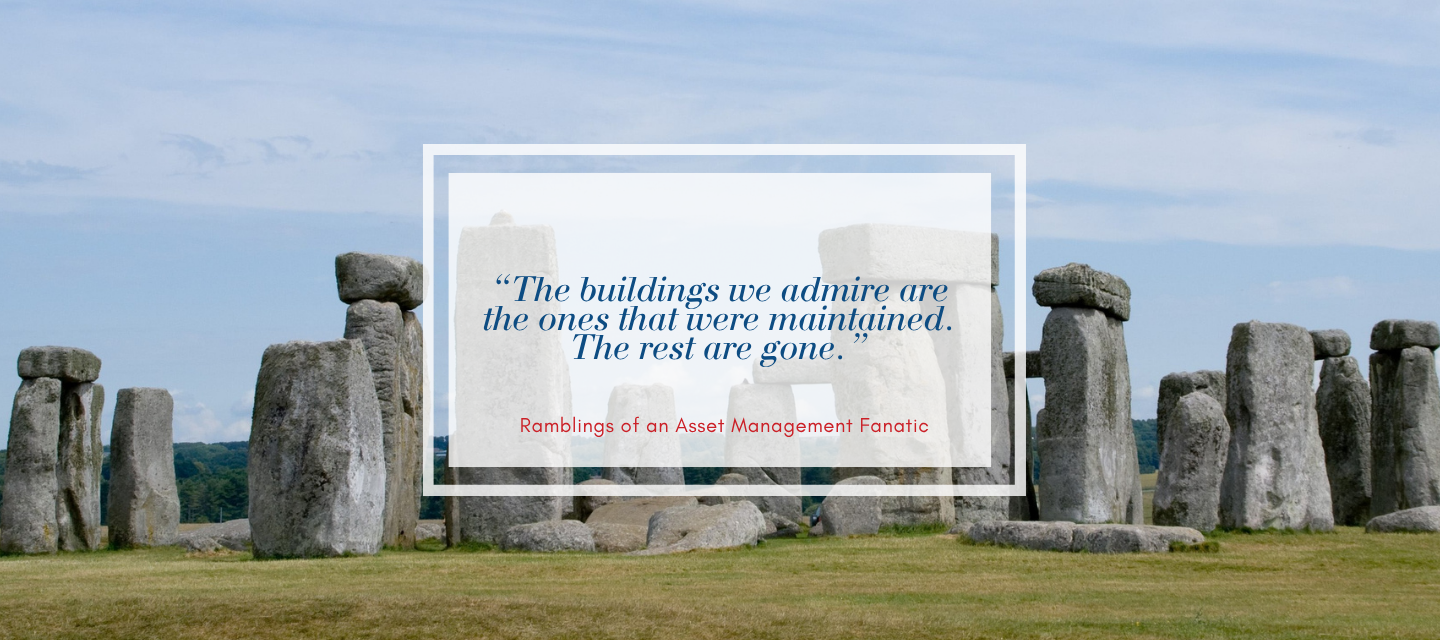
Standing at Stonehenge, I tried to wrap my head around how people with stone tools moved, shaped, and raised stones weighing dozens of tonnes — and aligned them with the summer and winter solstices. The mortise and tenon joints on the trilithons blew me away. The engineering is genuinely stunning.
But here’s the thing that hit me a few hours later: most of Stonehenge isn’t there anymore. Ancient Britain was covered in stone circles and monuments. We admire Stonehenge because it’s what survived. That’s a different story than “they built things to last.”
2. Windsor Castle – 900+ years of active planning and management
Construction on Windsor Castle began just before 1100 and it is still the working residence of the King. St George’s Chapel is breathtaking — the resting place of Queen Elizabeth II, Henry VIII, and many other royals. (No photography allowed on the tour, unfortunately, or I would have tried to capture the whole place.)
What I kept thinking about as I walked through was this: Windsor Castle has been under continuous renovation for nine centuries. It’s been expanded, modified, partially rebuilt, and — after the 1992 fire — significantly reconstructed. It isn’t standing because it was built perfectly in 1100. It’s standing because every generation for nine hundred years took its renewal seriously.
3. Oxford – a city-sized lesson in stewardship
Given how much of our work is with higher education institutions across North America, I was especially looking forward to visiting Oxford. Walking between the colleges scattered throughout the town — it isn’t a campus, it’s a city — and seeing students today learning in buildings that predate North American colonization was something I won’t forget.
But again: those buildings didn’t just “last.” They’ve been re-roofed, re-pointed, re-glazed, re-plumbed, re-wired, and selectively rebuilt across centuries. Every generation of Oxford’s stewards made choices about what to preserve, what to renew, and what to replace. The buildings I walked through are the product of a thousand years of disciplined capital renewal decisions.
4. The reframe I came home with
I went to England half-expecting to come back grumbling about how we don’t build things like we used to. And there’s a version of that argument — modern construction schedules are tighter, modern buildings carry far more complex systems, and honestly, survivorship bias means we’re comparing our full building stock to their greatest hits.
But the real lesson isn’t about how they built. It’s about how they maintained and renewed.
DCRM isn’t a modern issue. Every generation of building owners has faced it. The ones that addressed it with discipline gave us the buildings we cross oceans to see. The ones that didn’t gave us ruins — and mostly, we’ve forgotten their names.
Every cathedral, every college, every castle still standing is a thousand-year argument for taking capital renewal seriously. They’re not counterexamples to our DCRM crisis. They’re examples of what’s possible when someone commits to stewardship, generation after generation.
So the question I came home with isn’t “why can’t we build like they did?” It’s a harder one, and it’s aimed squarely at us. The buildings we have right now — the ones on our campuses, in our cities, in our portfolios — how will the next generation of stewards talk about the decisions we made? Will they walk through buildings we kept standing? Or will they wonder what used to be there?


