Downsizing Space is Never Just About Buildings
Over the past several posts, we explored a challenge that many organizations eventually face but few talk about openly. What happens when you realize you simply have more space than you need? For many organizations, that realization begins with a Facility Condition Assessment (FCA). Leaders finally see their portfolio clearly. They understand what they own, what condition it is in, and what it will cost to sustain it.
But as we discussed in the first post in this series, FCAs are just the beginning.
Once organizations truly understand their facilities, they are often forced to confront a much harder question – do we still need all of this space?
At first glance, the answer may seem straightforward. Enrollment shifts. Service models change. Utilization drops. The logic suggests that space should follow. In practice, it rarely does. That is because downsizing a facilities portfolio is almost never about buildings alone. It is about people, identity, governance, and public perception.
Across the sectors we explored in this series, the specific challenges looked different. But the underlying dynamic was remarkably consistent.
The Same Challenge Shows up in Different Ways
In K-12 education, school buildings often serve as community anchors. Closing a school can feel like removing a neighborhood institution, even when consolidation may lead to better learning environments for students.
In healthcare, facilities represent access to care. Adjusting a physical footprint can quickly become a conversation about response times, equity, and public safety.
In higher education, space often becomes intertwined with identity and influence. Square footage can quietly evolve into a proxy for importance, making space decisions as much about governance as facilities.
In municipal and state government portfolios, buildings serve as visible symbols of public services. When a facility closes or relocates, communities often interpret it as government withdrawing, even when the services themselves remain.
Different sectors. Different pressures. But the same fundamental reality.
The Emotional Side of Space
Facilities professionals and finance leaders tend to approach buildings rationally. They look at condition, utilization, cost, and Deferred Capital Renewal and Maintenance (DCRM) exposure. Those metrics are essential. But they rarely settle the debate on their own. Because for most stakeholders are human, buildings represent something else entirely.
- Community
- Security
- Status
- Presence
Until leaders acknowledge those emotional and political dimensions, space decisions will continue to stall, even when the data is clear.
Reframing the Conversation
Organizations that successfully right-size their portfolios tend to shift the conversation away from buildings and toward outcomes.
Instead of asking – “Who owns this space?” They ask – “What should this space accomplish for the organization?” That shift changes everything. It allows leaders to focus on mission, service delivery, and long-term sustainability rather than defending historical allocations or reacting to immediate pressures. More leaders need to frame facilities as strategic assets that support the mission of their organization.
This is where integrated asset management becomes so valuable. FCAs provide visibility into the condition and cost of the portfolio. Space planning provides insight into how that space is actually being used. Together, they create a shared understanding of reality. And that shared understanding is what allows organizations to make responsible decisions about their future footprint.
Leadership is the Real Deciding Factor
Ultimately, downsizing space is a leadership challenge. It requires balancing data with emotion. Operational efficiency and community impact. Long-term sustainability with short-term discomfort.
Organizations that navigate this well do not avoid the conversation:
- They lead it,
- They communicate early,
- They explain the reasoning clearly,
- And they recognize that the goal is not fewer buildings.
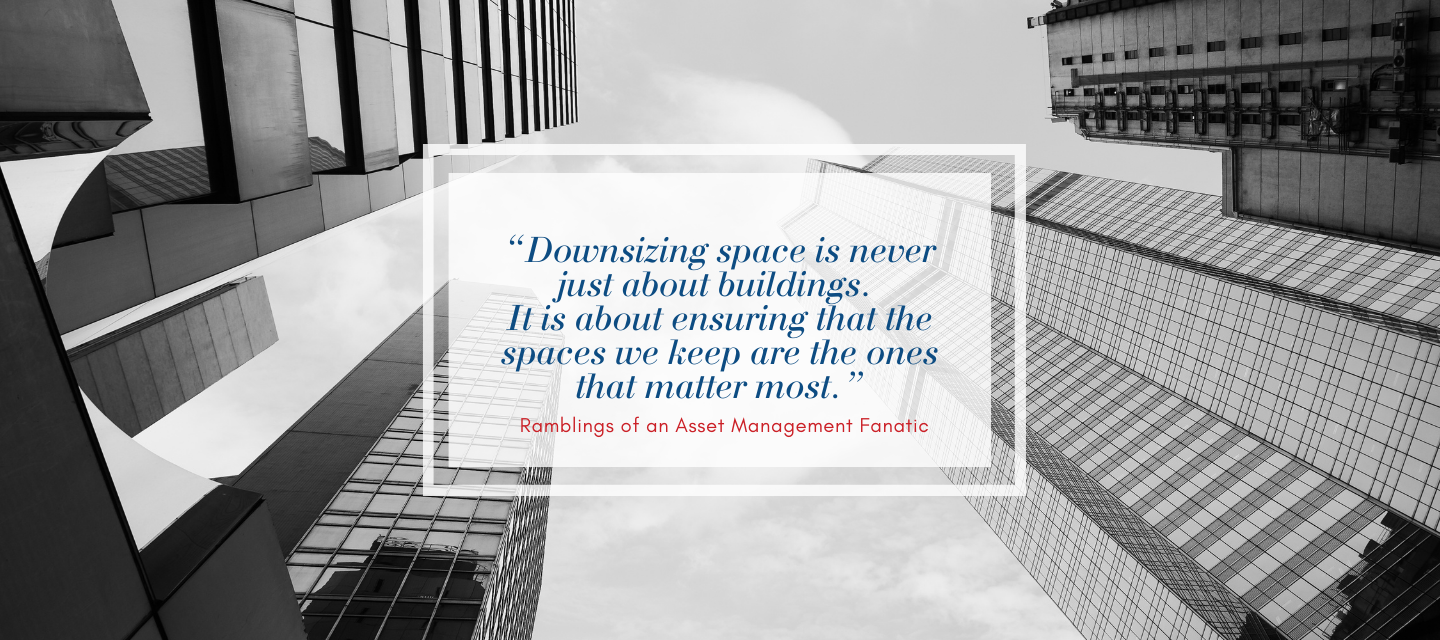
It is facilities portfolios that support how their organizations operate today and how they must evolve tomorrow. Because in the end, downsizing space is never just about buildings. It is about ensuring that the spaces we keep are the ones that matter most. And that conversation is where true asset management leadership begins.
Thanks for joining me on this series. We will be back next week with a brand new topic focused on facility and infrastructure asset management and leadership.


