
Garbage in is Still Garbage Out
If you have attended a conference, spent any time online, or even just watched the news lately, you cannot escape it. Artificial Intelligence, or AI, is seemingly everywhere. It is being touted as the solution to almost every problem imaginable, and the facilities and asset management (FM/AM) world is no exception.
Software vendors are adding “AI-powered” to their marketing materials at a dizzying pace, conference sessions on the topic are standing room only, and no shortage of thought leaders are telling us that AI is going to fundamentally transform the way we manage our buildings and infrastructure. This feels a lot like the greenwashing phase of the Sustainable Buildings revolution of the early 2000s. At the time everything was slapped with a green label. Now AI is the new green! Just as greenwashing eventually gave way to genuine sustainability standards, the AI hype cycle will likely settle into something more grounded.
I am not here to tell you that AI is not a powerful and exciting technology. It is. But I am also not here to fan the flames of hype without some important context. At Roth IAMS, we have spent years helping organizations build consistent and defensible data foundations that support good decision-making. And as AI tools become more prominent in our industry, I think there are two critical issues that are being lost in all of the excitement. Over the next two posts, I want to talk about both of them.
Today, I want to start with what I believe is the most fundamental issue of all: the quality of your data.
AI is Only as Good as the Data you Feed it
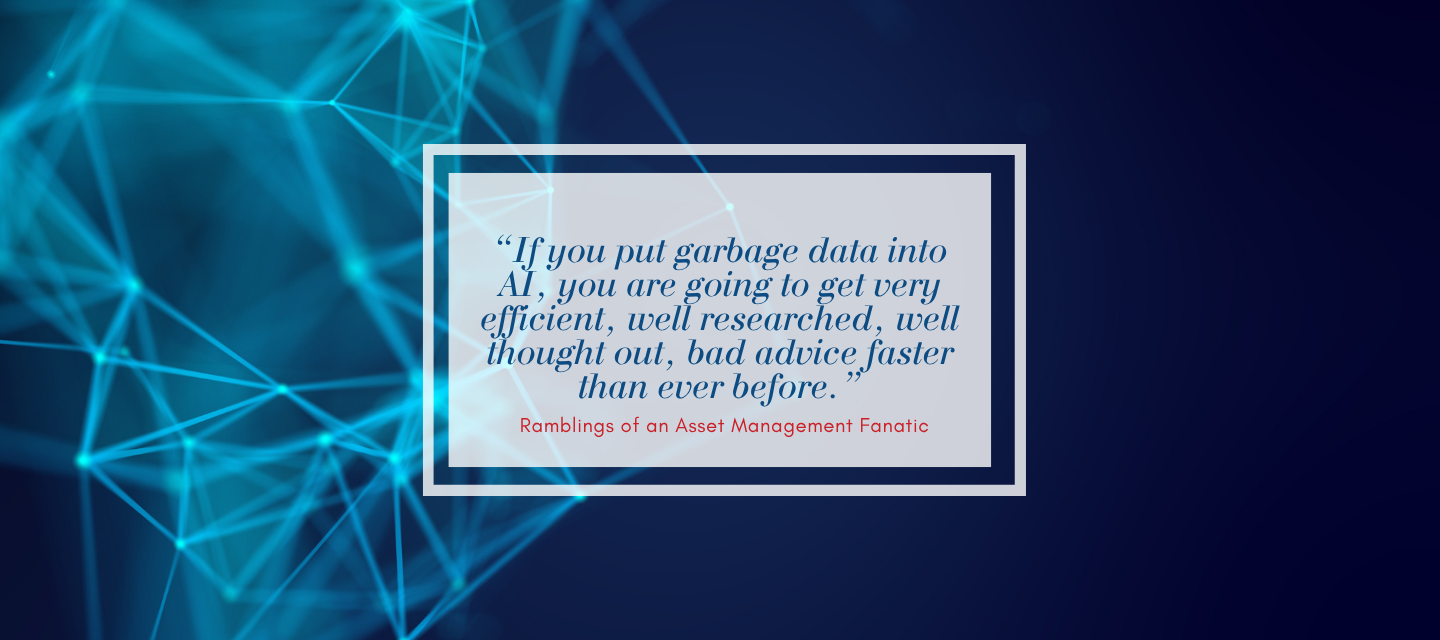
You have probably heard the expression “garbage in, garbage out.” It has been around forever in the world of data and computing, and it has never been more relevant than it is today when we are talking about AI. If you put garbage data into AI, you are going to get very efficient, well researched, well thought out, bad advice faster than ever before. This should not be the goal for anyone!
AI tools, whether they are being used to predict equipment failures, optimize maintenance schedules, or prioritize capital renewal investments, do not generate insights out of thin air. They analyze data. They look for patterns, model scenarios, and surface recommendations based on the information they are given. If that information is incomplete, inconsistent, outdated, or simply inaccurate, the AI will still produce an output. It just will not be a reliable one.
This is a real problem in our industry. Many of the organizations we work with are still operating with significant gaps in their facility data. Aging equipment inventories that have not been updated in years. Facility Condition Assessments (FCAs) that were done a decade ago and no longer reflect reality. Maintenance records that live in spreadsheets or, worse, in someone’s head. When we talk about AI in the context of facilities and asset management, we are often talking about layering a sophisticated analytical tool on top of a very shaky data foundation.
It starts with an honest assessment of the data you currently have: what exists, what is missing, and what is unreliable. From there, organizations can begin to prioritize the data collection and management activities that will set them up to actually take advantage of what AI tools have to offer. The good news is that this is a simple problem to solve, but not always easy to do.
Having a detailed end-to-end data strategy has never been more critical than it is right now. Those with the best data have always “won” the funding race. AI, with its speed and capabilities, is only going to amplify the difference between the haves and the have nots, when it comes to solid facility data. The “Haves” will be able to unlock the power of AI insights, while the “Have Nots” will either be left behind, or will end up off-track based on bad advice from AI.
I often say that good data tells your asset management story. If that is true, and I firmly believe it is, then clean, current, and comprehensive data is the foundation on which any meaningful use of AI must be built. Without it, the most sophisticated AI tool in the world is just telling you a story that isn’t true.
Are you and your team confident that you have a solid data foundation on which to build your AI strategy?
In next week’s post, I will tackle the second critical issue: the role of the human being in the AI equation, and why I believe we are a long way from letting AI make our decisions for us.


